
The Words Matter: Why Journaling Belongs on Our Scrapbook Pages

Over the past few weeks, I've been sharing the reasons behind some of the choices I make when I scrapbook.
We started by talking about The Power of White Space and why I love giving the elements on my pages room to breathe. Last week, we talked about why Your Photos Should Be the Star—because ultimately, the beautiful papers and embellishments we love are there to support the memories captured in our photographs.

But there is one more piece of my scrapbooking philosophy that may be the most important of all.
The words matter.
A photograph can show us a beautiful moment. It can show us who was there, what someone looked like, where we traveled, or what we were doing. But there are some things a photograph simply cannot tell us.
It can't tell us what happened five minutes before the picture was taken.
It can't tell us why everyone was laughing.
It can't tell us what Grandma always said when the family gathered around her table.
It can't tell us that the vacation almost didn't happen, that the toddler had just thrown a spectacular tantrum, or that the ordinary-looking Tuesday afternoon in the photograph became one of our favorite memories.
Those things live in the story. And if we don't write them down, someday they may be lost.
A Photograph Captures the Moment. Words Give It Meaning.
I love photographs. Obviously! I wouldn't have spent all these years scrapbooking if I didn't.
But I've learned that a photograph and its story are two different things. We sometimes assume we'll always remember the details because they're so clear to us right now. Of course we'll remember where we were. Of course we'll remember who was standing next to our Mom. Of course we'll remember why that particular day mattered.
Until we don't.
Time has a way of quietly taking away details we were certain we'd never forget. Years later, we may recognize every face in a photograph but have no idea what everyone was celebrating. We may remember the vacation but not the funny thing that happened on the way there. We may know whose birthday it was but forget the story behind the cake.
That's why I believe journaling deserves a place on our scrapbook pages. The photograph preserves what we could see.
The journaling preserves what we knew, felt, heard, and experienced.
Together, the photograph and journaling tell a much richer story.
Journaling Doesn't Have to Be a Perfectly Written Story
I think one reason scrapbookers sometimes avoid journaling is because the word itself can feel intimidating. We look at that empty journaling box and suddenly feel as though we're supposed to become authors.
How do I start?
What should I say?
Is my handwriting good enough?
What if I make a mistake?
What if I don't have enough room?
And sometimes it's simply easier to put another embellishment in that space and call the page finished.
But journaling doesn't have to be eloquent.
You aren't writing a novel. You aren't submitting your scrapbook page for a grade. You don't have to find the perfect opening sentence. Try to look at it like this. You are simply leaving clues for the person who will someday look at that photograph—including your future self.
Start with the basics if that's all you have.
Who is in the picture?
Where were you?
When was it taken?
What were you doing?
Why did you take the photograph?
Then go one little step further.
Why does this memory matter to you?
That question is where journaling becomes something more than documentation.
Go Beyond the Who, What, Where and When
Names, dates and places are important. I absolutely want those details preserved.
But they're only the beginning. Some of the most meaningful journaling comes from answering questions that aren't visible in the photograph.
How did you feel?
What were you thinking?
What made everyone laugh?
What happened that you never expected?
What family tradition were you celebrating?
What did that person always do or say?
What do you hope you'll remember about this season of life?
These are the details that turn a collection of facts into a story.
Imagine a photograph of a child standing beside a lake. We can write:
"Emma, Lake Superior, August 2026." That information has value.
But what if we also write:
"Emma couldn't wait to get to the water. She kicked off her shoes before anyone could stop her and spent the next hour looking for the 'perfect' rock to bring home. She finally chose one about the size of her hand and carried it everywhere for the rest of the trip."
Now we know Emma.
That's the difference the words can make.
The Ordinary Stories May Become the Most Precious
We naturally think to journal about the big events.
Weddings.
Graduations.
Birthdays.
Vacations.
Christmas.
Those stories certainly deserve to be preserved.
But I have come to believe that some of the most valuable stories in our albums may be the ordinary ones.
What did Saturday mornings look like in your house?
What meal did everyone request for their birthday?
Where did Dad always sit?
What was Grandma's favorite saying?
What did your children call each other when they were little?
What did you do every summer?
What did the house sound like when everyone was home?
These details feel insignificant while we're living them because they're simply part of everyday life.
But everyday life changes.
Children grow up and move away. Family routines disappear. Houses are sold. Traditions evolve. People we love are no longer sitting in their familiar chairs. And suddenly, the ordinary details don't feel ordinary anymore. They become the things we wish we could remember.
That's why I don't believe we should wait for an extraordinary event before we tell a story.
Ordinary life is worthy of being remembered, too.
Your Voice Belongs in Your Albums
There is another reason I believe journaling matters that we don't talk about often enough.
When you write the stories, you become part of the scrapbook. Many of us are the memory keepers in our families. We're behind the camera. We're organizing the photographs. We're creating the pages. And sometimes we unintentionally leave ourselves out. Our albums contain everyone else's faces and everyone else's milestones, but very little about the person who lovingly put all those pages together.
Journaling changes that. Your words preserve your voice.
They reveal what made you laugh, what you valued, what you noticed, what you were proud of, what surprised you, and what you loved. Someday, someone may read those words and hear you in them. I think that's incredibly powerful.
You don't have to write something profound. In fact, the little expressions you naturally use may become some of the most treasured parts of your albums because they sound like you.
Don't edit all of your personality out of the story. Let your family hear your voice on the page.
Handwriting Has a Place, Too
I'll admit that handwriting can be another stumbling block. We compare our handwriting to beautiful fonts and perfectly printed journaling cards, and suddenly ours doesn't seem good enough.
But think about an old handwritten recipe card from your mother or grandmother. Do you notice whether every letter is perfectly formed? Probably not. You see her handwriting. And somehow that makes the recipe card more precious.
Our handwriting is part of us.
That doesn't mean every scrapbook page has to contain handwritten journaling. There are wonderful reasons to type stories, especially when you have a lot to say or want to fit a longer story into a smaller space.
But don't avoid handwriting because you think yours isn't beautiful enough. Your handwriting doesn't have to be beautiful to be meaningful. Even a handwritten date, name, caption, or short sentence adds a little piece of you to the page.
Sometimes One Sentence Is Enough
Not every photograph needs three paragraphs of journaling. Some stories need space. Others need only a sentence. I've created pages where there was a lot I wanted to say, and I've created pages where a few words were enough. The important thing is that we don't let the desire to write the perfect story keep us from writing anything at all.
If you have room for one sentence, write one sentence. If all you remember is who, where and approximately when, write that. If the only thing you want future generations to know is, "This was one of the happiest days of my life," write it. That single sentence tells us something the photograph never could. I would much rather leave behind an imperfect sentence than a perfectly decorated page that leaves someone wondering what the photograph meant.
You Don't Have to Journal the Same Way on Every Page
Journaling can become part of the design rather than something we squeeze into whatever space is left.
It can be written on strips.
It can fill a mat card.
It can follow the edge of a circle or another shape.
It can be tucked into a pocket when the story is personal.
It can become part of a border.
It can be typed and printed.
It can be handwritten directly onto the page.
It can even be a short list of favorite memories rather than paragraphs.
There is no one correct way to do it.
In fact, thinking about the journaling early in the design process can make it much easier to include. If I know I have an important story to tell, I want to reserve space for it before the page becomes filled with other elements. That story deserves a place just as much as the photographs do.
Don't Wait Until You Remember Everything
Sometimes we don't journal because we can't remember all the details. I understand that.
Maybe you're scrapbooking photographs from twenty years ago. Perhaps no one remembers the exact date. You aren't certain which restaurant you were at or what year that vacation happened.
Write what you do know.
"I don't remember exactly where we were, but I remember how hard we laughed."
That's journaling.
"I wish I could remember the name of this beach, but I will never forget how much Dad loved being near the water."
That's a story.
We don't have to pretend our memories are perfect. In fact, admitting what we don't remember can make the journaling feel more authentic. And sometimes one memory leads to another. A photograph may prompt a phone call to a sibling, a conversation with an older relative, or a message to someone who was there. Suddenly you're not only creating a scrapbook page—you're reconnecting with the story.
Journaling Is a Gift to Our Future Selves
Last week, I wrote about something I've been thinking about more and more. We often talk about scrapbooking as a legacy we're leaving for our children and grandchildren. And it certainly can be. But what if our children don't want all of our albums someday? Does that make the years we spent creating them less valuable? I don't believe it does.
Because these albums are also for us.
Someday, we may be the ones sitting in a favorite chair, pulling an album from the shelf and turning through the pages. A photograph may remind us of the trip. But our own words may bring back the details.
We may read something we wrote twenty or thirty years earlier and suddenly remember the sound of someone's laugh, the excitement we felt before a journey, or the sweetness of an ordinary afternoon we hadn't thought about in years. What an incredible gift to give our future selves. Our legacy isn't only about telling our story to the people who come after us.
Sometimes our legacy is preserving our story so that we ourselves
can remember the life we've lived.
Someday, Someone May Be Grateful You Wrote It Down
There is no way to know who will eventually read the words we put into our albums. Maybe it will be your child. Maybe a grandchild. Maybe a niece or nephew. Maybe someone several generations from now who never had the opportunity to meet you. Or maybe it will simply be you.
But whoever turns those pages will know more because you took the time to write. They won't have to wonder who that person was. They won't have to guess why that day mattered. They won't have to create a story around a photograph because the real story disappeared.
You left it for them.
And that's one of the most loving things we can do as memory keepers.
The Page Isn't Finished Until the Story Has a Place
Throughout this series, I've shared three ideas that guide the way I scrapbook.
I love white space because it gives the page room to breathe.
I believe photographs should be the star because the people and memories matter more than the products.
And I believe the words matter because photographs alone cannot tell the entire story.
Together, those three ideas have shaped my scrapbooking style. They remind me that my goal isn't simply to create something beautiful. It's to preserve something meaningful.
Years from now, no one may remember which paper collection I used or how long it took me to create the perfect embellishment cluster. But someone may look at a photograph, read the words beside it, and understand something about our family that they never knew before.
They may laugh. They may remember. They may feel connected to someone who is no longer there. Or I may be the one turning those pages, reading my own words and remembering a moment I thought I would never forget. That's why I make room for the story.
Because the photographs show us the moments we lived.
The words help us remember what those moments meant.
And that, for me, is what scrapbooking has always been about.

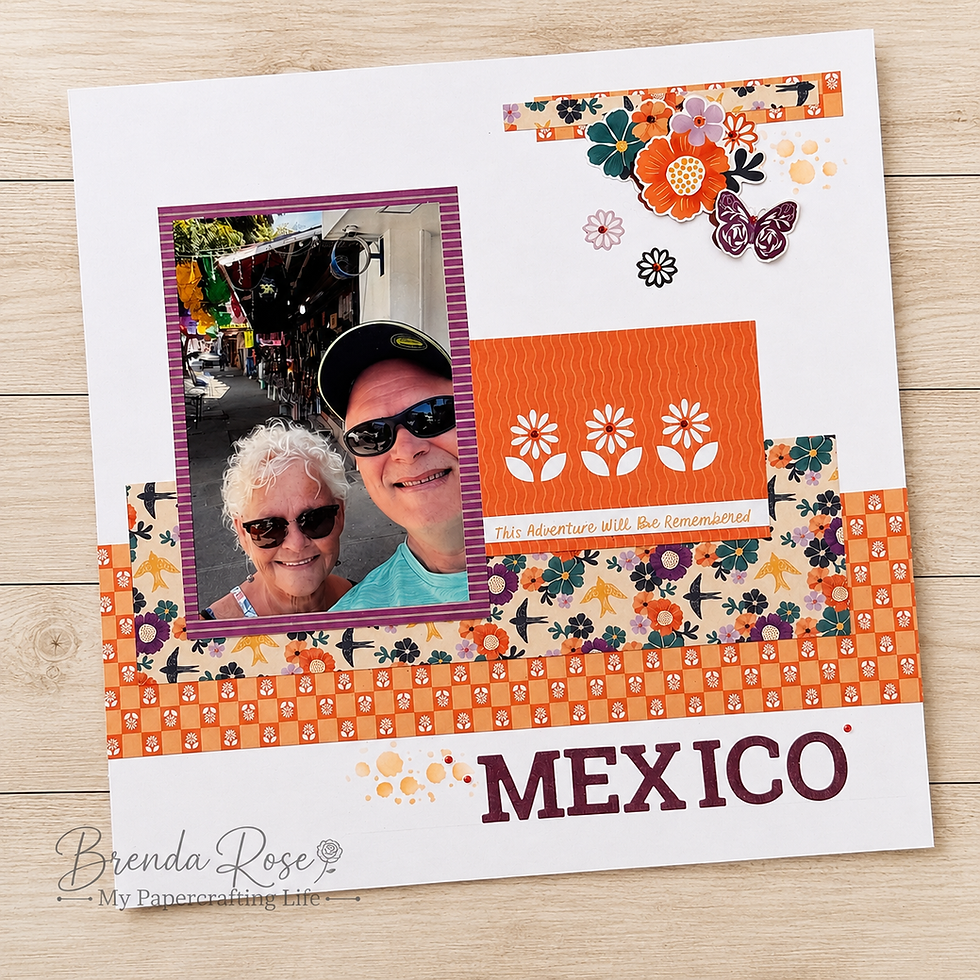

I have come to realize how important the stories are behind the photos. Now I see there are different ways to tell the stories. Thank you for that! And this blog is beautifully written.